Sidewalks & walkways · Hutto, TX
Concrete sidewalk contractors for Hutto front walks and public sidewalks
Two different jobs share a name. The walk to your front door is yours to plan. The sidewalk along the street sits in the City's right-of-way, and the City sets the rules.
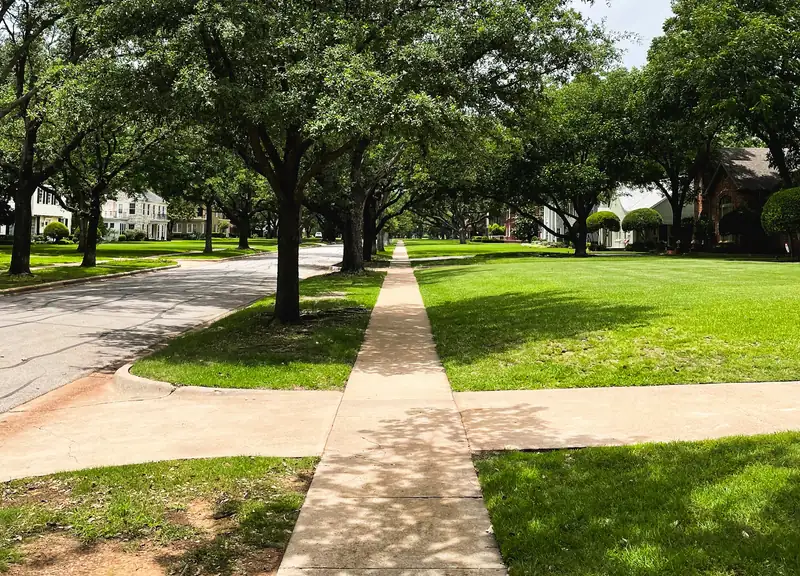
Public sidewalks
Concrete sidewalk installation to Hutto's right-of-way rules
Six layers of rules on one stretch of public sidewalk. Switch them on one at a time.
Mark up a public sidewalk section
Tick a layer to draw its markup on the plan; untick it to clear the sheet. Several can be on at once.
SHEET RL-1NOT TO SCALE · PLANNING SKETCH
Planning sketch from Hutto's right-of-way manual, UDC Ch. 4, the 2024 IRC and IPMC amendments, and TxDOT Item 531 as a published benchmark. Sidewalk width and standard details come from the City's design manual and the existing walk.
Clearances
Sidewalk concrete contractors keep clear of trees and hydrants
Where a walk goes is partly your call and partly the City's.
Two Hutto rules decide a lot of walk layouts. For newly planted trees, the UDC says no paving within 6 feet of the trunk or within the half critical root zone, whichever is greater. And the City's property maintenance code keeps hardscape 3 feet away from fire hydrants, utility poles and drainage inlets in the right-of-way.
The first one is about your new oak as much as the City's: a walk poured tight to a young tree is the walk that tree lifts in ten years. The second keeps hydrants and inlets reachable.
Try it on the plan: slide the walk and move the tree until every line is clear.
Lay out a walk around a tree and a hydrant
Drag the walk up or down and drag the tree. Keyboard: focus either handle and use the arrow keys.
- New tree to walk: 6.0 ft (needs 6 ft or half the root zone) clear
- Fire hydrant to walk: 6.0 ft (needs 3 ft) clear
- Utility pole to walk: 6.5 ft (needs 3 ft) clear
- Drainage inlet to walk: 8.5 ft (needs 3 ft) clear
Planning illustration of two City of Hutto rules (UDC tree protection; IPMC 302.14 as amended). Your lot's right-of-way line, easements and existing trees decide the real layout, and work in the right-of-way needs a City permit first.
Private walks
Concrete walkway contractors for front walks and side yards
On your own lot, the rules loosen and the design choices start.
Hutto's local code amendment exempts sidewalks that are no more than 30 inches above grade from a building permit, as long as they don't serve a required exit door. That covers most front walks and side-yard paths. Your HOA may still have a say on the look.
A front walk usually ties into the driveway. Hutto's code wants sidewalks and driveways doweled together, which keeps the joint from becoming a step. If the driveway is being replaced too, pour them on the same mobilization; the driveway page covers that side.
Side-yard walks earn their keep in Hutto: they keep bin day out of the mud on clay that turns slick after rain. Give them a gentle slope away from the house and a broom finish across the direction of travel, the same transverse broom TxDOT specifies for its sidewalks.
Joints matter more on a walk than anywhere else, because a walk is long and narrow. We cut them close to square panels so cracks land in the joint, and we run them to every corner where the walk changes direction.
Field notes: problem panels
Sidewalk contractors near me: raised and sunken panels
A walk is a row of thin slabs on clay. When one moves, everyone trips on the edge.
-
Tree roots lifting one corner
Live oaks are a Hutto staple and their roots follow moisture under the nearest slab. Replacing the panel without dealing with the root just resets the clock. -
Clay heave along one side
A walk next to a lawn that's watered every night swells on that side. Water management is part of the fix. -
Settled panels at driveway crossings
Where a driveway crosses the walk, traffic and old utility trenches show up as dips. Those panels get thicker concrete and dowels both sides. -
Lips over ¼ inch
¼ in. is the abrupt-change limit public walks are held to. Anything bigger is a trip hazard worth fixing, public or private.
Most of these are panel replacements: saw at the joints, remove, fix the cause, re-pour with dowels to the neighbors. Small stable lips can be ground. Cracked-but-level panels can often be left alone or sealed; the repair page goes into those fixes.
Put a public sidewalk panel replacement in order
Move the steps with the arrows until the order looks right to you, then check it against ours.
- 1 Ask the City, then file the ROW permit
Our step 1. Hutto's code doesn't say who repairs an existing public walk, so the first call is to the City. If it's yours, the right-of-way permit is filed in GovWell, and work has to start within 90 days of issue.
- 2 Written notice to the neighbors
Our step 2. Adjacent occupants get written notice at least 72 hours before work starts.
- 3 Texas811, and find the laterals
Our step 3. 811 locates are required for any excavation in the right-of-way. Water and sewer laterals and storm pipes aren't located by 811, so the crew finds them before the saw comes out.
- 4 Closure sign up, saw at the joints, remove
Our step 4. A walk closed more than a day gets a 3 × 3 ft sign. Sawing at the existing joints leaves clean edges to dowel into.
- 5 Fix what moved the panel
Our step 5. A root, a leaking line or a soaked strip of clay. Skip this and the new panel lifts or drops the same way the old one did.
- 6 Dowel, pour, broom across the walk
Our step 6. At least 2 dowels at each expansion joint into the neighbors, cross slope no more than 2%, no lip over ¼ in., and a broom finish across the direction of travel.
- 7 Cure, open, final inspection
Our step 7. TxDOT cures its sidewalks for at least 72 hours, and we use that as the floor before the walk reopens. Then the City inspects and the permit closes.
From Hutto's right-of-way manual, its IRC amendment and TxDOT Item 531 as the published curing benchmark.
Cost
Sidewalk cost factors
Walks are small jobs, so setup and paperwork weigh more per foot than on a driveway.
Right-of-way paperwork
Public sidewalk work carries a ROW permit, neighbor notice and inspection; private walks usually don't.
Removal
Sawing at the joints and hauling broken panels, plus root work if a tree caused it.
Sidewalk length and width
Linear feet and width set the concrete; small runs are mostly setup cost.
Joint tie-ins to driveway and steps
Dowels into the driveway, steps or the existing walk at each end.
Ramps and slopes
Curb ramps and walks that have to meet slope limits take more forming and checking.
Questions
Sidewalk and walkway questions
Do I need a permit to replace my front walk?
No, usually not for the private walk on your lot. Hutto's code exempts sidewalks not more than 30 in. above grade from a building permit (unless they serve a required exit door). The public sidewalk along the street is different: work there needs a right-of-way permit.
Who fixes a raised public sidewalk panel in front of my house?
No published Hutto rule we could find says. The City's code covers who installs sidewalks in new subdivisions (the developer), not who repairs existing ones. Ask the City first; if the answer is you, we pull the ROW permit and do it.
How wide should a front walk be?
3 to 4 feet, in our experience, works for one person; wider if two people walk side by side or it doubles as the path for trash bins. Public sidewalks follow the City's design manual, so we match the existing walk there.
Can you grind a trip edge instead of replacing the panel?
Yes, for a small, stable lip. If the panel is still moving with a tree root or the clay, grinding buys a season or two; replacing the panel with dowels and a fixed root problem is the lasting fix.
Is a walk in Old Town treated differently?
Yes, possibly. New construction visible from the street in Hutto's historic district may need a Certificate of Appropriateness from the Historic Preservation Commission before permits. Like-for-like repair is generally treated as ordinary maintenance; ask before changing material or layout.
Start a quote
Ask about a walk or sidewalk
Tell us whether it's the public sidewalk or your own walk, and send a photo of the problem panels or the route you have in mind. We're a concrete contractor in Hutto, so the ROW permit is on us.
- Call or text: (737) 201-1843
- Photos and plans: info@eliteconcretehutto.com